
Writing Interactive Fiction with Inform 7

Writing interactive fiction is a fun way to create a simulated environment that includes creating a game world with items, characters, and puzzles. The best part is that you don’t need to learn complex graphics application programming interfaces (API).

Using Inform 7, it is easy to write your own interactive fiction without knowing how to program.  That’s right, you can create your own game world by writing natural language descriptions, that the Inform 7 compiler can use to build your game world.

Inform 7 is an Integrated Development Environment (IDE). The Inform 7 IDE is an all-in-one editor, compiler, and game interpreter.  Inform 7 runs on OS X, Linux, and Windows.


We’ve created a simple exploration simulation, that you can play:

Using your favorite Secure Shell client, open a SSH session to:


Interested in learning more?

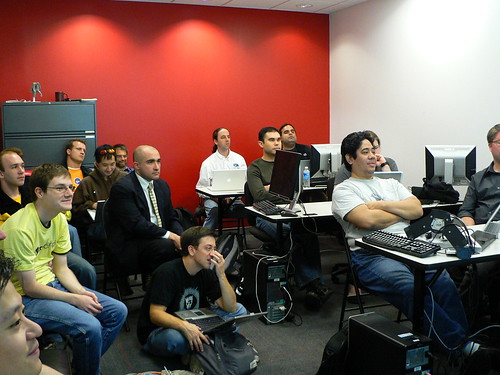
HacDC will be hosting an introductory class at the end of January.  The class will show you how to create a simple game world with items, characters, and puzzles. To sign up, send an e-mail to: rdegraci _at_ gmail.com with the subject line “Interactive Fiction: Sign me up”. The deadline to sign up is January 21, 2009.
Categories: Uncategorized

First Tuesday Seminar Series with DorkbotDC Overlords: Dec. 9 at 8:30 PM

When: Tuesday, 09 December 2008 @ 8:30 PM
Where: HacDC (St. Stephen & The Incarnation Church, 1525 Newton St NW, Washington DC)
Cost: FREE

In our first Tuesday Seminar Series, Dorkbot DC overlords and brand new HacDC Members Gareth Branwyn and Alberto Gaitán will join fellow HacDC Members Katie Bechtold (DC Linux Chix) and Nick Farr (hackerspaces.org) in a conversation on building the DC Tech Community.

This is the first of a series of Tuesday Seminars designed to help bring local geeks, dorks, makers and hackers closer together.   Taking place most Tuesdays at 8:30 PM when Dorkbot is not in session, HacDC’s TSS will feature a wide range of topics and interactive opportunities of general interest to DC’s finest hackers.  (It also helps HacDC make sure its member meetings end on time.)

This Tuesday’s TSS builds on our previous community-building conversation, Birthing Hydra, which took place during HacDC’s “Grand Opening Week”.  Following a seminar format, we hope to arrive at a framework of common strategies for:

  1. Building and maintaining the “organizing infrastructure” of DC’s tech community.
  2. Creating and cultivating more attractive social and collaborative gatherings and spaces.
  3. Reaching out to future community members and connecting our disparate pockets of activity. 

Next week’s TSS will be on lasers!  If you have an idea for a Tuesday Seminar Series topic, please e-mail info@hacdc.org.  To keep up to date on our events, check out hacdc.org or sign up for our announce list!

Categories: Uncategorized

Dorkbot Overlords now HacDC members!

In appreciation for their incredible assistance in helping launch HacDC, Dorkbot DC overlords Gareth Branwyn and Alberto Gaitán were inducted as full-fledged HacDC members at our December 02 member meeting.

Once they get keys to the place, we’re sure they’ll be redecorating with some steampunk gadgets and painting robots.

More on Gareth:

Gareth Branwyn writes about technology and tech culture. For 12 years, he was a contributing editor at Wired, co-creating and writing the Jargon Watch column. Through that work, he was asked to be the consultant on computer and Internet terms for the Oxford American Dictionary. Gareth is currently a contributing editor for O’Reilly’s MAKE magazine and Make: Blog, and he’s also an editor at Make: Books.

Gareth is also the author of numerous books, including the first book about the World Wide Web (Mosaic Quick Tour: Accessing and Navigating the World Wide Web) and The Happy Mutant Handbook (which he co-wrote with Mark and Carla of Boing Boing). He recently contributed the introduction to Device 1: Fantastic Contraption, a book celebrating post-industrial surrealism, published by Device Gallery and IDW Publishing.

More on Alberto:

Alberto Gaitán was born in Quito, Ecuador, moving to DC when he was 14. He has since worked as a composer and programmer in the DC metropolitan area working collaboratively in cross-media projects with DC’s best musicians, poets, choreographers, and visual artists. His new-media work has included the very first computer-based installation presented in a DC nightclub, as well as some videography and photography. He has been working with digital audio, including sampling and synthesis, and computer controlled interactive sound environments since 1985.

His music has been played in the Kennedy Center and in performance spaces around DC and in Europe. His work with collaborative artist group Art Attack International has won international critical acclaim and his solo sonic pieces have been presented internationally and locally. He has written music for conventional ensembles and for the less conventional, such as automobiles. His road-based sound installation, Loci, was commissioned by Arlington, Virginia, and by the city of Aachen, Germany. Arlington County has also commissioned him to create a permanent, net-aware, interactive sound sculpture at the site of the original courthouse.

He has written for exhibition catalogs and for publications including The Washington Post, Kustforum (DE), The Baltimore Sun, and The Millennium Whole Earth Catalog. He has lectured nationally on the collaborative process at universities and galleries and taken part in peer review panels, including the National Endowment for the Arts’ New Forms Regional Grants Initiative. He recently developed, Remembrancer, a cybernetic, net-aware piece for a solo exhibition at Curator’s Office, in DC, April/May 2007 as part of ColorField Remix, a Washington, DC, citywide project, spanning the spring and summer of 2007 and linking numerous art venues to celebrate the many legacies of the generation of Color Field and Washington Color School artists.

Categories: Uncategorized

Yeast engineered to produce new fuel source – still some hacking left to do!

There has been some significant progress in engineering our favorite yeast, Saccharomyces cerevisiae, (brewer’s yeast!) to produce n-Butanol rather than ethanol.  This is particularly interesting from a fuel production standpoint, since there are major advantages of n-Butanol over ethanol for fuel.  From a recent Green Car Congress post:

Butanol has a number of advantages over ethanol for use as a biofuel—it is more hydrophobic; has a higher energy density; can be transported through existing pipeline infrastructure; and can be mixed with gasoline at any ratio.

As someone who spent a lot of time genetically engineering organisms, this is an important milestone.  There remains a lot to be done, but at least the beginnings of an approach as been outlined by this research. The paper (available open access here) has a lot of follow-on information about likely approaches to improve the process and/or yield.  This is where hackers can jump in and possibly make a contribution- a lot of the basic stuff can be based on computational approaches and dynamic simulation.  Let a million flowers (or yeast) bloom!